
Before Translating a POA for UAE Use: Five Checks
Before translating a Power of Attorney, identify the receiver, confirm the document route, send every page and separate translation from drafting.
Request document translation
We provide document translation only. We do not provide attestation services. For official attestation or application requirements, contact the relevant authority.
The words “I need a POA translated” leave out the most important facts: does the document already exist, who will use it, and what does that receiver require?
A Power of Attorney is an authority document. It identifies who grants authority, who may act, what acts are allowed and where those powers stop. Translation should reproduce that map in another language. It cannot create a missing power, choose the right grant for a transaction or make the source legally sufficient.
If you already have the instrument, use the Power of Attorney translation page for a document check. If it does not exist—or the powers need changing—use the POA drafting route and obtain the legal or notarial input appropriate to the intended act.
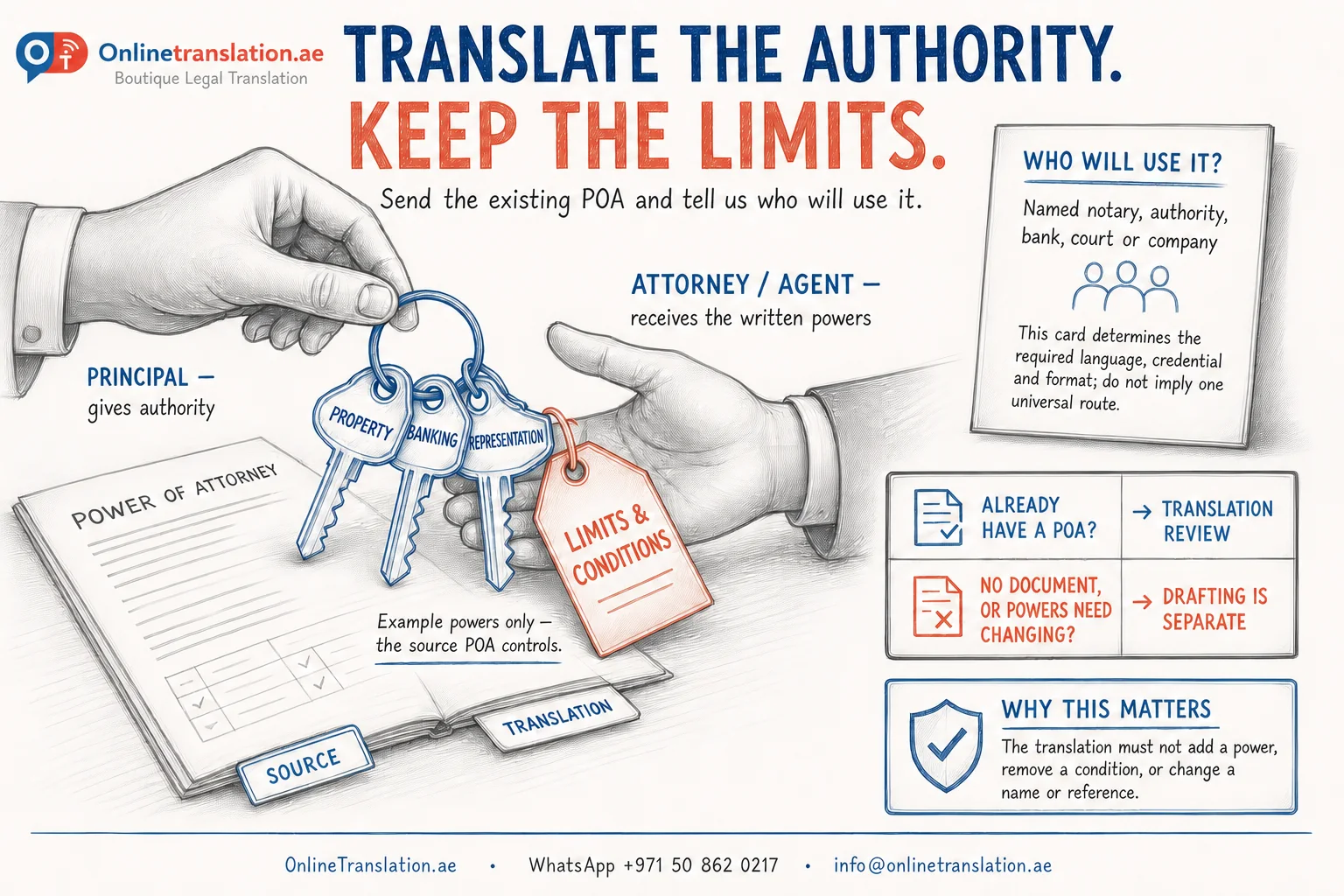
The key labels are examples. The source POA—not the illustration or translator—controls the authority granted.
Check 1: translation or drafting?
OnlineTranslation.ae is an independent service partner. Arabic–English legal translation is performed by MOJ-licensed legal translator Mohamed Khalid (personal MOJ Licence #688, valid until 8 March 2029; Al Qemma Legal Translation). The licence is held by the translator, not by OnlineTranslation.ae. We work with partners including Arkan Legal Translation and
MOJ Licensed Legal Translator Mohamed Khalid (MOJ Licence #688) — Al Qemma Legal Translation (DED Licence 876257)
Start with the simplest question: is there already a POA to translate?
- Existing POA, wrong language: translation may be the job.
- No POA exists: the legal powers must be drafted first.
- Existing POA, but a power is missing or too broad: changing the instrument is drafting or amendment work, not translation.
- Existing English-Arabic instrument for a named UAE notary: use the focused notary-submission document check.
A translation can misstate authority if it is inaccurate, but it does not legally rewrite the source. The provider should not “improve” the grant, add an operation because it seems useful or remove a condition because it appears inconvenient.
Check 2: name the exact receiver and use
“UAE use” is not a complete destination. The receiver may be:
- a government, private or electronic notary service;
- a court, tribunal or legal team;
- Dubai Land Department or another transaction-specific authority;
- a bank, company or free-zone entity;
- a private counterparty.
Ask for the current language, credential and file-format instruction. Name the Emirate and service, not only the organisation.
For example, Dubai Courts’ current Power of Attorneys Ratification service says documents not in Arabic need UAE Ministry of Justice-certified legal translation and foreign-issued supporting documents must follow its listed attestation route. That is useful for that named service. It does not prove that every POA, notary, bank or court follows an identical route.
Dubai law recognises government, private and electronic notary channels. The notary checks matters such as identity, capacity, consent and awareness of the instrument. Translation prepares language content; it is not the notarial act. See the notary-versus-translation guide if that distinction is unclear.
Check 3: confirm the document route before translation
An instrument issued in the UAE and one issued abroad may not follow the same path. Requirements also depend on the receiving service.
Do not copy a universal country table from an article. Ask the receiving notary or authority what must be completed on the original.
If the receiver expressly confirms UAE MOFA attestation is required:
- complete the required attestation on the original POA;
- wait until the final stamp, sticker or annotation is present;
- send the complete final document for translation.
This order matters because the final attestation details may need to appear in the translation. If nobody has asked for MOFA, do not order it from this guide alone. Read the conditional MOFA-first sequence for that narrow situation.
MOFA attestation and translation perform different jobs. MOFA describes attestation as verifying the validity of the seal and signature on a document. Translation conveys the visible content in another language.
Check 4: send the complete authority map
Do not send a cropped signature page or one clause in isolation. Include:
- every numbered page, annex and reverse side;
- visible notarial text and final attestation pages;
- the principal’s and agent’s approved name references;
- company, property, account, case or transaction identifiers already in the source;
- any clause about limits, duration, expiry, delegation or substitution;
- the receiver’s instruction and real deadline.
The translation check should identify four parts:
- Principal: who grants authority.
- Attorney or agent: who receives it.
- Named acts: the transactions or decisions actually written.
- Limits and conditions: where the authority stops, including joint or separate action when the source states it.
Labels such as “general,” “special” or “limited” do not replace reading the clauses. Two documents with the same label may grant very different authority.
For property use, send the exact DLD service or transaction instruction. DLD’s published frequently asked questions says a representative may act only within the limits stated in a duly legalised POA. The translator can reproduce those limits; the translator cannot decide whether the source grants the power required for your transaction.
For court representation, let the lawyer or receiving court identify what authority is needed. Articles 58–61 of the Civil Procedure Code address representation and acts that require special authorisation. Translation does not choose that grant.
Check 5: confirm the deliverable before payment
The written confirmation should state:
- source and target language;
- exact document, version, pages and annexes included;
- registered legal-translation provider when the receiver requires one;
- digital or physical delivery format;
- quote and realistic turnaround after file review.
For a translated deed or document accepted by a court or used in authentication or certification, the UAE law regulating the translation profession generally requires a translator or translation house listed under that framework, subject to its limited exception.
OnlineTranslation.ae coordinates document review, customer support, logistics and delivery. Where UAE Ministry of Justice legal translation is required, the written quote identifies the partner handling it (such as Arkan Legal Translation or Al Qemma Legal Translation, or another MOJ-licensed translator we work with) and the licensed translator before payment.
That credential does not authenticate the source, determine validity, notarise signatures or ensure that a receiver will accept the POA.
If the POA was returned
Ask for the written return note before ordering another translation. A return can concern different problems:
- a power or supporting document is missing from the source;
- a page or annex was omitted;
- a name or identifier does not match the receiver’s record;
- an attestation step the service expressly required is incomplete;
- the wrong language or provider credential was used;
- the upload, pagination or file format does not match the service instruction;
- the translation itself contains an error.
A new translation can correct a translation error. It cannot add authority missing from the POA, complete an authentication step or overrule the receiving body. Related case: POA Drafting vs Translation: Why Prices Differ.
Send the return note, complete POA and current instruction together. That lets the provider separate a translation correction from a source-document, drafting, attestation or submission problem before quoting.